The interest sparked by the Great Green Wall: a meeting between the Executive Secretary and the Second Secretary of the United States Embassy in Mauritania
May 17, 2017
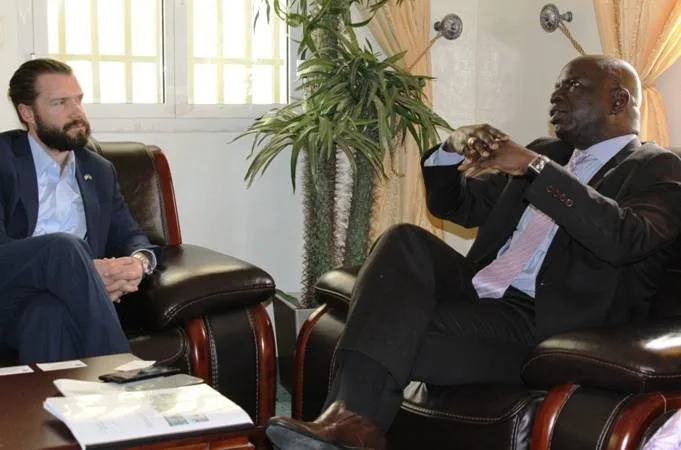
“I am counting on the support of the United States of America in implementing the Great Green Wall,” said Prof. Abdoulaye Dia, Executive Secretary of the Pan-African Agency of the Great Green Wall (PAGGW).
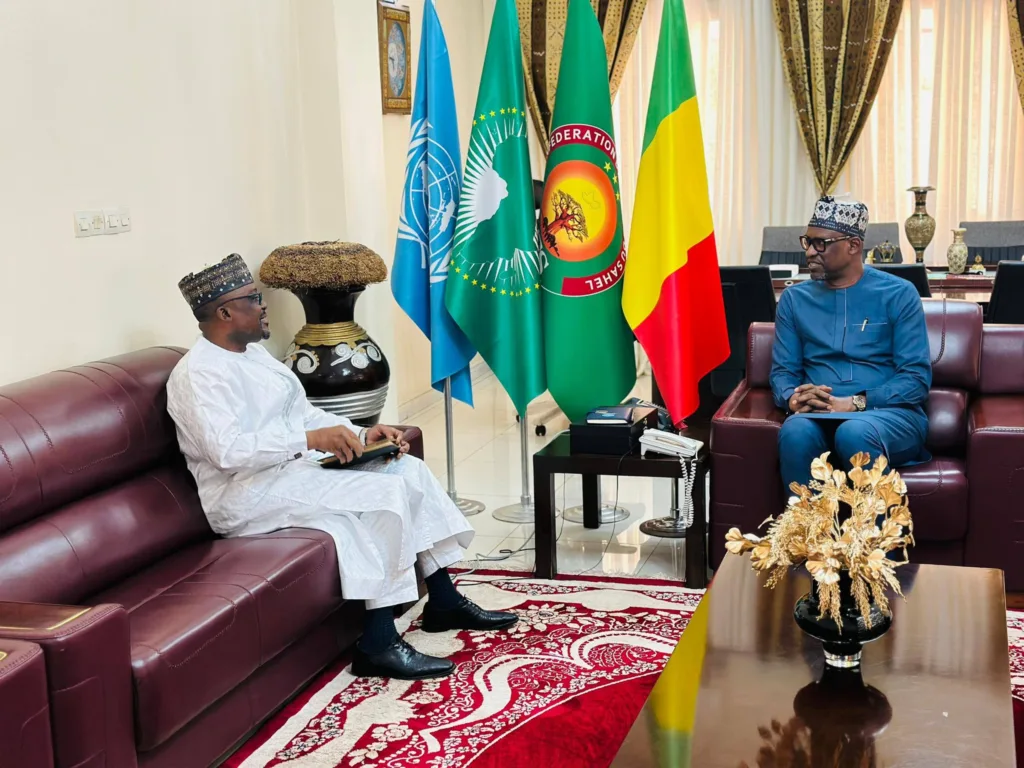
Prof. Abdoulaye Dia, Executive Secretary of the Pan-African Agency of the Great Green Wall, surrounded by his close associates, received late this morning Chris Molitoris, Second Secretary of the Embassy of the United States of America in charge of economic and commercial affairs, who had come to familiarise himself with the approach of the Great Green Wall. This meeting took place as part of the introductory rounds of the American diplomat, who has just taken up his post in Mauritania, with the development organisations present.
During the discussion held in his office, the Executive Secretary explained that the PAGGW is an intergovernmental organisation created by the Heads of State and Government of the member States — Burkina Faso, Djibouti, Eritrea, Ethiopia, Mali, Mauritania, Niger, Nigeria, Senegal, Sudan and Chad — under the aegis of the African Union, by an international Convention signed in N’Djamena (Chad) on 17 June 2010, with its headquarters in Mauritania since 11 May 2013.
He added that the overall objective of the PAGGW is to combat deforestation, in particular through the restoration of degraded landscapes, so as to contribute to the well-being of the populations of the arid and semi-arid areas of the Sahel. The Executive Secretary noted that one of the distinctive features of the Great Green Wall approach is to take into account the various United Nations conventions related to the environment.
The PAGGW, an innovative approach to targeting rural areas
For the Executive Secretary, “the famine afflicting the Sahel could have been avoided if action had been taken at the local level by involving the populations,” thereby underscoring the relevance of the Great Green Wall approach, which, in his view, must be supported by substantial financial resources. On this point he stated: “I am counting on the support of the United States of America in implementing the Great Green Wall.” Such support will prove useful for the application of the PAGGW’s 2016–2020 Strategy.
Illustrating the Great Green Wall approach, the Executive Secretary gave the example of the Integrated Community Agricultural Farms (FACI), which, based on a relatively modest initial investment, involve local populations and have made it possible to establish farms carrying out several crops that generate income, enabling other activities to be undertaken for the benefit of the communities.
After listening attentively to the explanations of Prof. Dia and his close associates, Chris Molitoris had the look of a diplomat both enlightened about the Great Green Wall and satisfied with the meeting and the follow-up that will result from it.