High-Level Joint Mission of the African Development Bank and the World Food Programme to the PAGGW: Towards an Expanded Strategic Partnership for Sahel Resilience
February 14, 2026
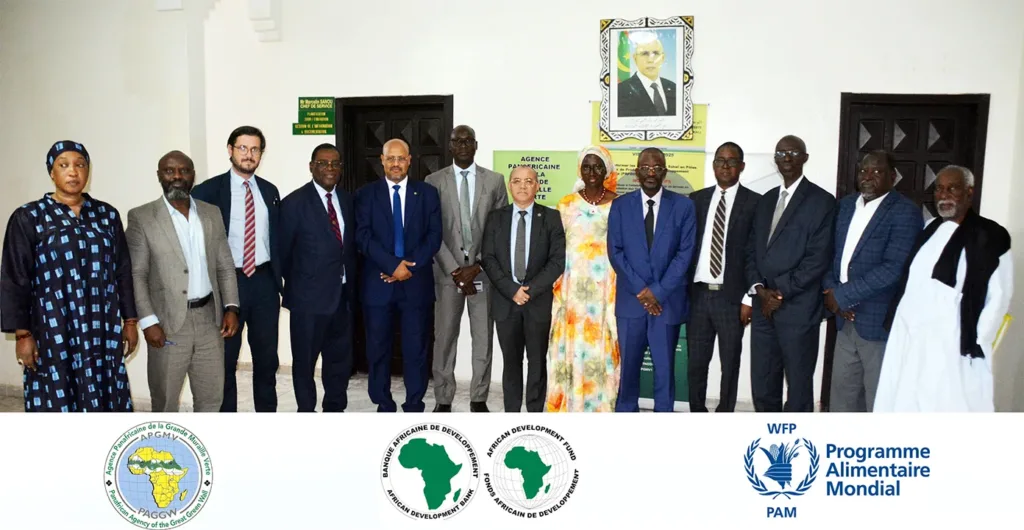
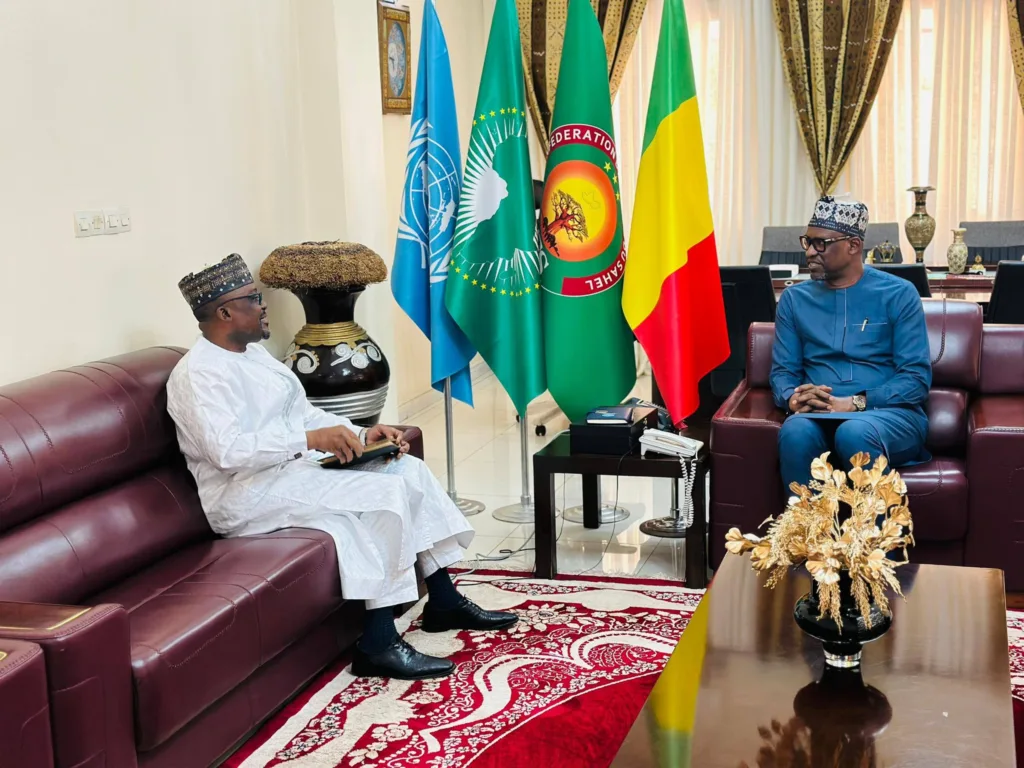
Nouakchott, 12 February 2026 – The Pan-African Agency of the Great Green Wall (PAGGW) hosted this Thursday a high-level joint mission of the African Development Bank (AfDB) and the World Food Programme (WFP), as part of an in-depth strategic dialogue devoted to the Sahel Resilience Initiative and to the prospects for scaling up structuring investments in support of resilience, food security and sustainable development in the Sahelian countries. The AfDB delegation was led by Laouali Garba, Head of the AHAI2 Division, while the WFP was represented by Kinday Samba, Regional Director.
An initiative stemming from an AfDB–WFP strategic dialogue
The mission follows on from the high-level exchanges between the AfDB and the WFP, prompted by the presentation of the significant results achieved by the WFP in implementing integrated resilience approaches in the Sahel, notably in Mauritania, Burkina Faso, Niger, Mali and Chad. These results, considered particularly convincing, sparked the interest of the AfDB in structuring a strategic partnership aimed at amplifying these interventions at the regional level, in line with the national priorities of States and existing regional frameworks.
 In this regard, the AfDB reaffirmed its ambition to increase development financing, strengthen the sovereignty and economic diversification of countries, harness the demographic dividend — particularly young people and women — and attract resilient investments that create local added value.
The WFP Regional Director, Kinday Samba, likewise reaffirmed her institution’s commitment to providing lasting support to the Sahelian countries, stressing that investing in resilience is an essential means of reducing the humanitarian burden over the long term and strengthening the self-reliance of communities.
The PAGGW, institutional pillar and unifying framework of regional resilience
Welcoming the mission, the Executive Secretary of the PAGGW, H.E. Mr Almoustapha Garba, stressed that the Sahel Resilience Initiative lies fully at the heart of the mandate and raison d’être of the Great Green Wall, a flagship African initiative conceived by and for Africans, in response to the multidimensional challenges of climate change, desertification, land degradation, rural poverty and insecurity.
He recalled that the PAGGW has a robust strategic framework, embodied in a Decade Priority Investment Plan (2021–2030), broken down into five-year plans, whose ambition is to: i) restore 100 million hectares of degraded land; ii) sequester 250 million tonnes of carbon; iii) create 10 million green jobs, primarily for the benefit of young people and women.
The exchanges made it possible to highlight the main areas of intervention carried out by the PAGGW, in full coherence with the priorities of the AfDB and the WFP, in particular: i) the sustainable management of land, natural resources and biodiversity; ii) climate action and the promotion of the green economy; iii) resilient economic development, closely linked to security and stability issues in the Sahel; iv) the strengthening of scientific, technical and institutional capacities, including the project to create a regional research centre dedicated to the Great Green Wall; and v) the establishment of innovative financing mechanisms, such as the carbon bank and a fund for climate change adaptation and resilience and local economic development.
The Executive Secretary also presented his model of integrated community farms (FACI), a Great Green Wall–labelled product, which combines agriculture, livestock farming, water management, land restoration and income generation for the benefit of local communities.
At the end of the visit, the parties agreed to continue the technical and strategic dialogue with a view to identifying concrete actions, suitable financing mechanisms and operational partnerships capable of accelerating the implementation of the Sahel Resilience Initiative. This mission thus marks a decisive step towards building a structuring and inclusive partnership, placing the Great Green Wall at the heart of an ambitious regional response for a Sahel that is more resilient, more productive and sustainably stabilised.