About the Great Green Wall
'%20fill-opacity='0.2'/%3e%3cpath%20id='Vector_2'%20d='M357.967%20119.302L379.617%20200.099L277.169%20140.951L357.967%20119.302Z'%20fill='var(--fill-0,%20%23C9A600)'%20fill-opacity='0.2'/%3e%3cpath%20id='Vector_3'%20d='M450.459%20242.625L408.635%20315.066L378.017%20200.8L450.459%20242.625Z'%20fill='var(--fill-0,%20%23C9A600)'%20fill-opacity='0.2'/%3e%3cpath%20id='Vector_4'%20d='M265.231%20456.546L206.083%20397.398H324.379L265.231%20456.546Z'%20fill='var(--fill-0,%20%23C9A600)'%20fill-opacity='0.2'/%3e%3cpath%20id='Vector_5'%20d='M408.698%20397.457H325.05L408.698%20313.809V397.457Z'%20fill='var(--fill-0,%20%23C9A600)'%20fill-opacity='0.2'/%3e%3cpath%20id='Vector_6'%20d='M126.483%20376.135L148.133%20295.337L207.281%20397.784L126.483%20376.135Z'%20fill='var(--fill-0,%20%23C9A600)'%20fill-opacity='0.2'/%3e%3cpath%20id='Vector_7'%20d='M106.582%20236.993L179.024%20195.169L148.406%20309.435L106.582%20236.993Z'%20fill='var(--fill-0,%20%23C9A600)'%20fill-opacity='0.2'/%3e%3cpath%20id='Vector_8'%20d='M158.154%2043.99L278.337%2076.1929L125.951%20164.173L158.154%2043.99Z'%20fill='var(--fill-0,%20%23C9A600)'%20fill-opacity='0.2'/%3e%3cpath%20id='Vector_9'%20d='M396.691%2044.3787L428.894%20164.562L276.508%2076.5816L396.691%2044.3787Z'%20fill='var(--fill-0,%20%23C9A600)'%20fill-opacity='0.2'/%3e%3cpath%20id='Vector_10'%20d='M534.269%20227.816L472.058%20335.569L426.516%20165.604L534.269%20227.816Z'%20fill='var(--fill-0,%20%23C9A600)'%20fill-opacity='0.2'/%3e%3cpath%20id='Vector_11'%20d='M258.751%20546.014L170.771%20458.034H346.731L258.751%20546.014Z'%20fill='var(--fill-0,%20%23C9A600)'%20fill-opacity='0.2'/%3e%3cpath%20id='Vector_12'%20d='M472.154%20458.122H347.732L472.154%20333.7V458.122Z'%20fill='var(--fill-0,%20%23C9A600)'%20fill-opacity='0.2'/%3e%3cpath%20id='Vector_13'%20d='M52.3684%20426.408L84.5713%20306.226L172.551%20458.611L52.3684%20426.408Z'%20fill='var(--fill-0,%20%23C9A600)'%20fill-opacity='0.2'/%3e%3cpath%20id='Vector_14'%20d='M22.7709%20219.436L130.524%20157.225L84.9821%20327.189L22.7709%20219.436Z'%20fill='var(--fill-0,%20%23C9A600)'%20fill-opacity='0.2'/%3e%3cpath%20id='Vector_15'%20d='M178.765%20203.271L235.95%20190.781L191.255%20260.456L178.765%20203.271Z'%20fill='var(--fill-0,%20%23C9A600)'%20fill-opacity='0.2'/%3e%3cpath%20id='Vector_16'%20d='M278.547%20151.931L317.957%20195.21L235.269%20191.34L278.547%20151.931Z'%20fill='var(--fill-0,%20%23C9A600)'%20fill-opacity='0.2'/%3e%3cpath%20id='Vector_17'%20d='M375.656%20198.897L372.92%20257.367L317.187%20196.161L375.656%20198.897Z'%20fill='var(--fill-0,%20%23C9A600)'%20fill-opacity='0.2'/%3e%3cpath%20id='Vector_18'%20d='M329.21%20391.375L273.441%20373.599L346.986%20335.606L329.21%20391.375Z'%20fill='var(--fill-0,%20%23C9A600)'%20fill-opacity='0.2'/%3e%3cpath%20id='Vector_19'%20d='M399.422%20308.569L347.418%20335.434L372.556%20256.565L399.422%20308.569Z'%20fill='var(--fill-0,%20%23C9A600)'%20fill-opacity='0.2'/%3e%3cpath%20id='Vector_20'%20d='M217.121%20385.953L204.631%20328.768L274.307%20373.463L217.121%20385.953Z'%20fill='var(--fill-0,%20%23C9A600)'%20fill-opacity='0.2'/%3e%3cpath%20id='Vector_21'%20d='M160.06%20305.837L191.664%20256.568L209.328%20337.441L160.06%20305.837Z'%20fill='var(--fill-0,%20%23C9A600)'%20fill-opacity='0.2'/%3e%3c/g%3e%3c/svg%3e)
In brief, desertification and land degradation are among the most pressing challenges in the Sahel, a region facing extreme poverty and highly vulnerable to climate change. These processes lead to reduced fertile land, lower rainfall levels, and consequently, declining lake and river ecosystems and food production, plunging rural communities into hunger and poverty. These conditions fuel unemployment, mainly in rural areas, trigger forced migrations and often lead to land conflicts and inter- and intra-community divisions. Across Africa, the Sahara Desert expanded during the 20th century and continues to grow (Thomas and Nigam, 2018). These challenges underscore the urgency of a coordinated regional solution for the arid and semi-arid landscapes of the Sahel.
The Great Green Wall (GGW) is a response and a monumental pan-African initiative to address these challenges at an unprecedented scale. Conceived as an 8,000 km corridor of Sahelian landscapes crossing the widest part of the continent, from the Red Sea in the east to the Atlantic Ocean in the west, the GGW prioritizes land and landscape restoration as a key strategy to strengthen food security and sovereignty, improve livelihoods and help communities adapt to climate change.
By 2030, the GGW aims to:
- Restore 100 million hectares of degraded land;
- Sequester 250 million tons of carbon equivalent;
- Create 10 million green jobs.
This Programme is led by the Pan-African Agency of the Great Green Wall, with support from the African Union Commission and Technical and Financial Partners. It is an ambitious programme primarily aimed at restoring lands, territories and landscapes, currently benefiting twenty-two (22) African countries. It thus revitalizes thousands of communities by bringing together African countries and international partners.
From a historical perspective, the fundamental idea that led to the creation of the GGW Initiative emerged from the General Assembly of the Community of Sahelo-Saharan States (CEN-SAD) where Heads of State and Government of this institution met in 2005 in Ouagadougou, Burkina Faso. At this General Assembly, the major issues caused by desertification were highlighted and the recommendation was made to develop a substantial and specific programme to combat this scourge that had annihilated the efforts of Sahelo-Saharan countries.
Following this important recommendation from CEN-SAD, and after two years of reflection, the “Great Green Wall Initiative for the Sahara and the Sahel” was created on January 30, 2007 “under the auspices” of the African Union at its General Assembly in Addis Ababa, Ethiopia.
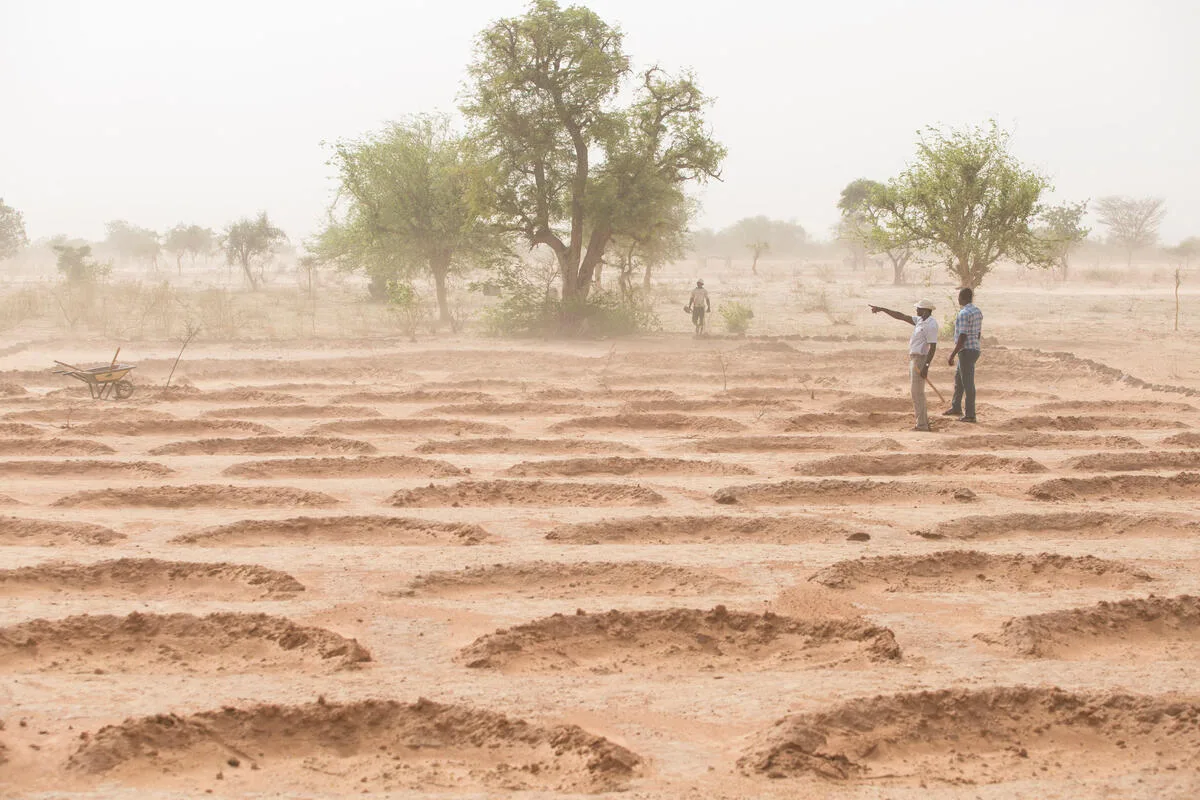
The Great Green Wall (GGW) is not simply a line of trees across the Sahel. It is a mosaic of sustainable land use and management practices that is being developed across 8,000 km from Senegal to Djibouti. The initiative uses a landscape approach to land restoration, combining multiple activities: planting trees, restoring natural vegetation, building water harvesting structures, supporting sustainable agriculture and creating sustainable livelihoods for communities.
Despite significant progress, the GGW faces several challenges including: securing long-term funding, ensuring coordination across the 22 member countries, addressing climate variability impacts, and scaling up successful restoration practices. Future perspectives include strengthening governance structures, increasing private sector engagement, and leveraging technology for monitoring and evaluation.
The Great Green Wall (GGW) is a monumental African Union-led initiative designed to combat the severe impacts of desertification, climate change, and land degradation across the Sahel-Saharan region. It is conceived as an 8,000 km corridor of landscape restoration stretching across the widest part of the African continent.
The GGW aims to transform Sahelian landscapes by Restoring 100 million hectares of degraded lands.
The primary motivation for the GGW arose from the realization that desertification, climate change, and land degradation were profoundly impacting the key drivers of economic growth, social cohesion, stability, and security in the Sahel-Saharan states. The recurrent and intensifying nature of these impacts, despite various existing action plans, highlighted the urgent need for a regional approach founded on common commitment and concerted actions.
The GGW is a flagship African-led program demonstrating how to leverage nature-based solutions to address complex environmental threats simultaneously, including land degradation, desertification, drought, climate change, biodiversity loss, poverty, and food insecurity. The Sahel region, where the initiative is primarily focused, is one of the world's poorest and most vulnerable to climate change, experiencing rising temperatures and an increased frequency of extreme weather events like prolonged droughts and torrential rainfall.
Awards
World Restoration Flagships. The African Great Green Wall was one of the first ten World Restoration Flagships awarded by the United Nations in December 2022. These pioneering restoration efforts highlight how environmental champions are restoring degraded ecosystems around the world.
Learn more
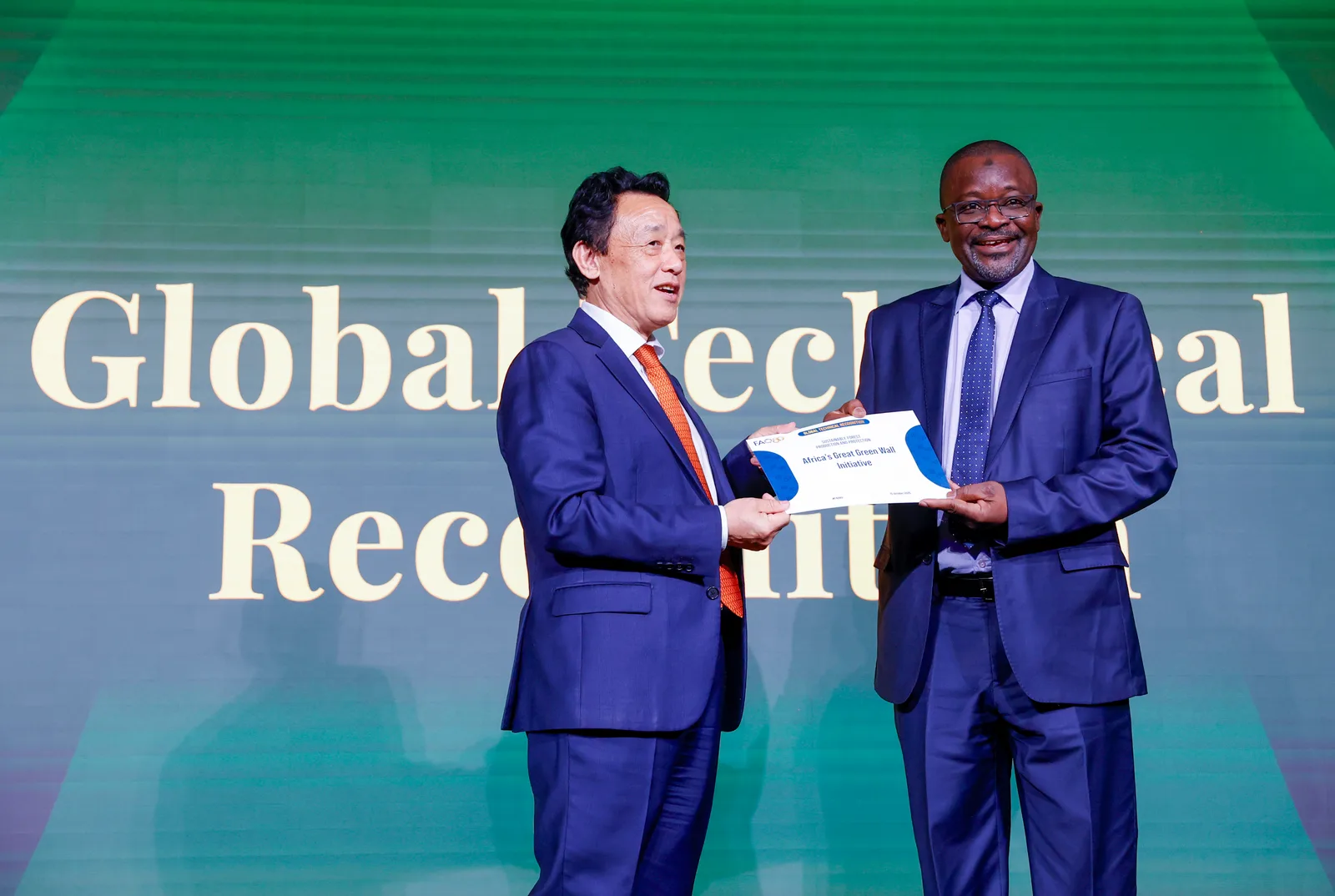
15 October 2025, Rome, Italy. FAO Director-General QU Dongyu (L) poses for a photo with one of the award winners. FAO Global Technical Recognition Ceremony. ©FAO/Giulio Napolitano.
To mark its 80th anniversary, the FAO honored 24 global forestry champions for their exceptional contributions to sustainable forest management and agrifood systems transformation. The recognition highlights innovative initiatives worldwide—from China’s Green Great Wall to Africa’s Great Green Wall and the Amazon Science Panel—advancing FAO’s “Four Betters.” These efforts showcase decades of progress in forest protection, restoration, and sustainable livelihoods.